My 7-year-old daughter, Autumn, and me were discussing how an atom is made up of mostly empty space with a small nucleus of protons and neutrons in the “center” and electrons swarming about it. During the discussion, she asked an insightful question,
“Can an atom have two cores (two nuclei)?”
At first, the answer to this question would seem to be a resounding, “No. An atom can have only one nucleus.” But not so fast: Earlier in the week Autumn and I were discussing the decay of radium into radon and alpha particles (helium ions). During this process, the radium nucleus ejects a helium ion and becomes a radon atom:
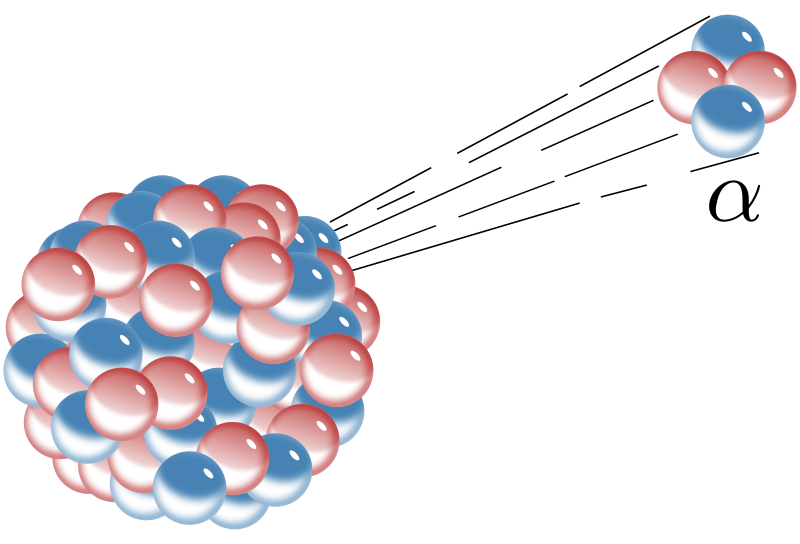 A picture of a radium nucleus ejecting a helium ion (wiki commons)
That means, for the briefest of time, there is a radon nucleus and a helium nucleus still inside the “center” of the atom, i.e., two nuclei!
This was NOT an answer to Autumn’s question, however: My physicists friends would probably point out that the helium ion is not actually considered to be a nucleus of the atom, but just a particle that was being ejected from the atom, and hence does not count as a counterexample to the statement, “An atom has only one nucleus.”
We discussed this “counterexample” and it became evident that alpha decay was not what Autumn had in mind. What she was really wondering was if there was a situation where an atom could actually have two nuclei in a relatively stable state for a period of time (a period long enough and nuclei that were predictively-stable enough to distinguish them from the general “soup” of strong forces involving protons and neutrons). This is why Autumn’s question was insightful. It was a question I did not have an answer for, and was not sure physicists did either. I told her that questions like her’s, even if they prove not to generate something new, help move science forward.
To my physicists friends: Is there already an answer to Autumn’s question? It seems to me that, as the number of protons and neutrons in a nucleus increases, there does come a point where one could imagine the electromagnetic forces may “balance” the strong forces enough for weird behavior like double nuclei to exists, at least for short periods of time in certain highly controlled situations. However, I am happy to concede that there may be a well-known fact (to physicists) that rules out such phenomena that I have just overlooked in my thinking about Autumn’s question. Please leave a comment below if you have an answer–Autumn wants to know!
p.s. If you like Autumn’s question, you should see her in action by watching her videos at the Growing up with Eureka channel.
CHANNEL: Baldridge Theorems
© 2016 Scott Baldridge


In a comment on LinkedIn, Preston MacDougall writes:
************************
Interesting and insightful question from a very bright prospective scientist. According to the Quantum Theory of Atoms in Molecules, some early computations of protonated systems, such as HF+, HNe+, and HHe+, lack a saddle point (minimum) in the total electron density between the nuclei, indicating a single quantum subsystem (atom). Most recently, however, using very high-levels of theory, only HNe+ survives as a possibility for a single quantum atom with more than 1 nucleus. Relatedly, there are many systems that have quantum subsystems (atoms) with NO nuclei! These are called non-nuclear attractors, and are common in lithium clusters, and perhaps in other special systems such as f-centers and solvated electrons.
*************************
To see his and other comments about this problem, visit: https://www.linkedin.com/pulse/can-atom-have-two-nuclei-inquisitive-child-wants-know-scott-baldridge
LikeLike
A simple answer is that two nuclei form a molecule, rather than an atom.
LikeLiked by 1 person
True, true. But I interpreted Autumn’s question as “two nuclei surrounding by electrons in one system,” not “a nucleus surrounded by its electrons attached (via electric charges) to another nucleus surrounded by its electrons” (a molecule).
LikeLike
It is indeed a very insightful question. It becomes an even more interesting question when you think of protons and neutrons as being made up of quarks. The strong nuclear force (holding protons together against their electromagnetic repulsion) is then viewed as being due to gluon exchange between quarks in neighbouring protons i.e. a residual force that stops the nucleons being repelled apart due to their charge. So, I would say for stable atoms there is only a single nucleus. However, the liquid drop model of fission probably comes closest to considering an atom like U235 as containing two nuclei (but only after absorbing a neutron to make it unstable via fission and only for a very short time). The recent discoveries of exotic particles called pentaquarks also raises the question of how the quarks are arranged inside the particle (e.g. just a “bag” of 5 quarks or a “molecule” of 2 and 3 particle states).
LikeLiked by 1 person
Thank you! You have given Autumn and me something to explore further.
LikeLike
I think the answer is no. There are distorted nuclear objects, but that distortion lasts for a very short time…certainly not long enough to have stable atomic orbitals. Something like a H2 atom shares electrons pretty freely, so there is a degree to which such an object kind of counts.
Here is a reference on highly distorted nuclei: https://physics.aps.org/synopsis-for/10.1103/PhysRevLett.116.112503
LikeLiked by 1 person
hmm
LikeLike
When an element is unstable it is because too many protons in the nucleus are too close and repelling to much away from each other. The result is the nucleus shredding it’s self so it can try to reconfigure in a more stable form. Ejecting particles is required to create a new formation of protons and neutrons. In some heavy element this is achieved by splitting the nucleus into two nuclei. In a fraction of a second the two nuclei will undergo fusion back to one nucleus which again ejects particles. Since the “daughter nuclei” that is created is not ejected from the atom it can still be considered part of the atom. Therefor the answer to your daughters question is technically YES when considering the shortest amounts of time.
LikeLike