There are professors who help build a math department, and there are mathematicians who help change the language of mathematics itself. Herman Lyle Smith did both.

At LSU, Smith stands as a giant at the beginning of the university’s mathematics Ph.D. tradition. In the wider mathematical world, his name still survives in a phrase every student of topology eventually meets: Moore–Smith convergence. Smith created one of the central tools of modern topology and analysis. For LSU, that alone should make him a figure worth remembering. For the history of mathematics, it makes him a figure worth honoring.
1. A life in mathematics
Herman Lyle Smith was born on July 7, 1892, in Pittwood, Illinois, and spent most of his youth in Oregon. His obituary in Mathematics Magazine reports that he attended the University of Oregon as an undergraduate, but received the B.S., M.S., and Ph.D. degrees from the University of Chicago. His doctorate was conferred in 1926, with E. H. Moore as his major professor. [2]
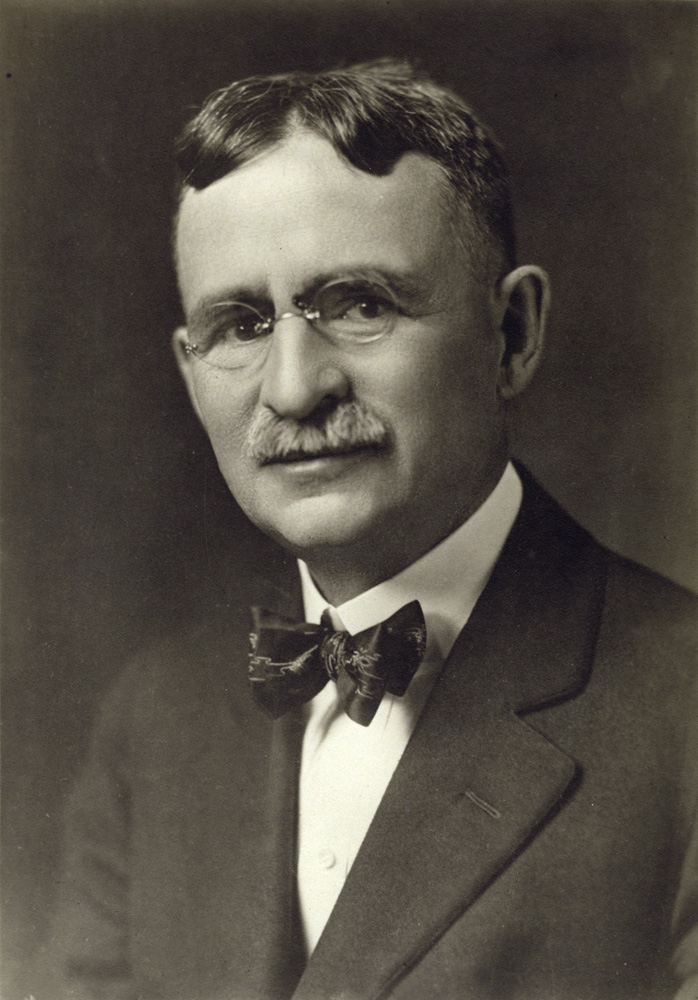
E. H. Moore, Smith’s doctoral advisor at Chicago, was one of the most influential American mathematicians of his generation.
That lineage mattered. Moore was one of the major architects of early twentieth-century American mathematics, and Smith emerged from that powerful Chicago tradition. (Moore is my great-great-great-grandfather advisor, for example.) Smith’s doctoral dissertation was titled The Minkowski linear measure for a simple rectifiable curve, but his most enduring work reached well beyond that dissertation. [2][3]
In fact, as a mathematician, his work extended beyond his advisor. His obituary says he published roughly 25 papers in top-ranked journals like the American Journal of Mathematics, the Transactions, the Annals of Mathematics, The Bulletin. He was an editor of the National Mathematics Magazine. He worked on the general theory of limits, the Stieltjes integral, approximation, and vector addition. [2]
2. LSU’s first doctoral lineage
The earliest currently documented mathematics Ph.D. in LSU’s online record is Frank Atkinson Rickey’s dissertation, Foundations of Differential Geometry, dated May 1, 1935. Rickey’s dissertation explicitly thanks Dr. H. L. Smith for his “suggestions and criticisms facilitating this work.” That makes Herman Lyle Smith the first clearly documented Ph.D. advisor in LSU mathematics. [5]
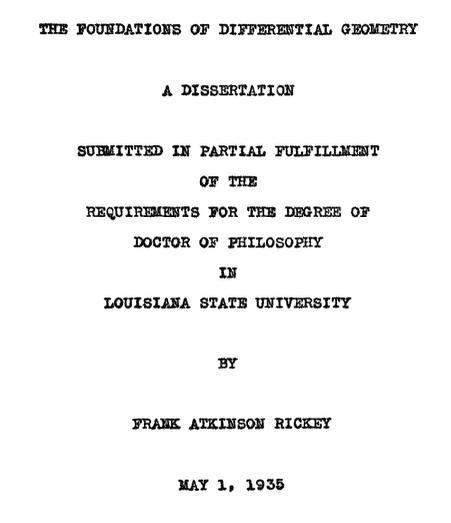
Rickey dissertation title page, and possibly the acknowledgments page naming Smith.
Rickey’s dissertation biography tells us something even more important. It shows that Rickey was studying and teaching at LSU in the 1929–1930 session, and then again in 1933–1934 and 1934–1935. In other words, LSU’s doctoral pipeline in mathematics was already taking shape by the late 1920s. Smith was not merely present at the beginning. He helped create it. [5]
Smith was also the advisor to Harry Taylor Fleddermann, whose 1940 dissertation belongs to LSU’s first generation of mathematics Ph.D.s. By the time Smith died in 1950, his obituary reports that two people were working with him as major professor toward the Ph.D. degree, and that several others were writing master’s theses under his supervision. That detail alone shows how deeply he was involved in building LSU’s graduate program. [2][6]
3. Moore–Smith nets: why Smith matters far beyond LSU
If Smith had only been an early department builder, he would still deserve a place in LSU history. But he was more than that. He helped create one of the enduring theories of modern topology and analysis.
In 1922, Smith and his advisor E. H. Moore published “A General Theory of Limits.” That paper introduced the machinery later known as nets. [4]
The underlying problem was simple to state. Ordinary sequences work beautifully in familiar spaces, but they do not always capture convergence in more abstract topological or analytical settings. Some spaces contain genuine limiting behavior that sequences are simply too weak to detect. Moore and Smith’s answer was to generalize the very idea of a sequence.
A net is, roughly speaking, a generalized sequence. Instead of being indexed by the natural numbers, it is indexed by a more flexible ordered structure called a directed set. That one move gave mathematicians a vastly more powerful way to talk about convergence. [4][8]
This was not a small technical tweak. It became a standard part of the language of topology. John L. Kelley’s classic 1955 textbook General Topology helped canonize the subject for later generations, and LSU’s own department history rightly remembers Smith as the “second-half” of Moore–Smith convergence. [1][8]
That is why LSU honors Smith not only as an early professor, but as a mathematician of genuine national and international stature. His name did not merely appear in a departmental ledger. It entered the vocabulary of mathematics.
4. The French connection and the “filter” controversy
Fifteen years after Moore and Smith’s 1922 paper, Henri Cartan introduced filters in 1937, along with the related notion of ultrafilters. That is where the story becomes more complicated—and more interesting. [7][9]
Henri Cartan introduced filters in 1937; through Bourbaki and the French school, that language became enormously influential.
To understand why, it helps to explain the mathematics in the clearest possible terms.
There are often two ways to describe the same topological phenomenon. A classic example is continuity: (1) you can define continuity in the language of limits, or (2) you can define continuity in the language of open sets. The relationship between nets and filters is very similar.
Nets are the limit-language version of generalized convergence:
- they track points;
- those points are indexed by a directed set;
- convergence means the points are eventually in every neighborhood of the limit.
Filters are the open-set or neighborhood-language version of generalized convergence:
- they track subsets of a space;
- those subsets are closed upward and under finite intersection;
- convergence means every neighborhood of the point belongs to the filter. [7][8]
That is why filters feel, mathematically, like the set-theoretic bookkeeping version of the same convergence phenomenon already captured by nets. Once the generalized notion of “eventually in every neighborhood” is in place, the passage from nets to filters is not a leap into a new universe. It is a recoding of the same underlying idea.
Historically, however, one should be careful. The best accounts do not say that Cartan simply copied Moore and Smith. Nets and filters are different formalisms. But they also say something equally important: on topological spaces, the two formalisms yield the same notion of convergence. [7][8]
So where did the controversy come from? In part, from influence. Cartan’s language entered the orbit of Bourbaki, the extraordinarily influential French mathematical collective whose style helped shape twentieth-century pure mathematics. Once Bourbaki gave filters its prestige, the French presentation gained circulation, authority, and staying power. From an American perspective, and especially from an LSU perspective, it is not hard to see why that later success felt less like a brand-new invention than like a very successful rebranding.
The deeper issue was not originality alone, but authority. Europe’s older mathematical institutions still carried enormous prestige, and Bourbaki’s French structural program acquired unusual power to define the modern style of pure mathematics. By 1940 American mathematics was already preeminent in many areas, but Bourbaki’s voice was especially successful at turning one way of presenting ideas into the “canonical one.” Smith thus fell into a familiar trap of intellectual history: he helped build the architecture early, but a later and more influential mathematical culture helped decide how it would be named. Smith’s case shows exactly how that process worked.
5. Vindicating Smith
The strongest case for Smith does not require exaggeration. It does not depend on saying that Cartan “stole” his work. The stronger and fairer case is simply:
Smith created the deeper architecture first.
In 1922, Moore and Smith had already built a theory of convergence that went far beyond ordinary sequences and captured nearly all of the important examples then under discussion. Cartan’s notion of filter addressed one important case that lay just beyond the reach of nets, and that helped the later Bourbaki tradition present filters as more independent of the earlier net framework than they really were. But Smith was already grappling with that case. His 1938 return to the subject widened the Moore–Smith program so that this missing case could be brought within his general theory as well. As Manya Raman-Sundström later observed, this was the path by which Smith independently arrived at the equivalent filter viewpoint—by extending the net framework itself. [7][10]
That independent rediscovery is not just folklore. In 1938, Smith published another paper titled “A General Theory of Limits” in National Mathematics Magazine. Later, E. J. McShane wrote that Cartan devised the filter theory in 1937, and that Smith expounded “this same theory,” apparently independently, in 1938. [10][11]
That 1938 publication matters. It does not erase Cartan’s coining of the word filter or his set-theoretic formulation of the concept, but it shows that Smith was not a forgotten bystander watching other mathematicians occupy his terrain. He was still actively developing the same conceptual ground.
And mathematically, the point remains striking: once nets are fully and properly understood, filters are a natural set-theoretic reformulation of generalized convergence. They are two ways of organizing the same topological behavior. In Raman-Sundström’s telling, nets and filters may look different on the surface, but in abstract topological spaces they yield the same notion of convergence. The correspondence is so close that Kelley could provide a standard dictionary between them in his 1955 textbook. [7][8]
So if one asks who first built the house—not merely who later repainted it—the answer leads back to Moore and Smith.
6. Remembering Smith
Herman Lyle Smith died suddenly on June 13, 1950, “without having been ill,” as Mathematics Magazine reported. His obituary reveals the full range of his mathematical life: researcher, editor, mentor, reviewer, and builder. He had published roughly twenty-five papers. He had served as an editor of the National Mathematics Magazine from its founding, and later of Mathematics Magazine. He even used his knowledge of Russian to write reviews for Mathematical Reviews. [2]
LSU’s own departmental history remembers him as one of the two best-known mathematicians in the department’s crucial 1920–1945 period, and associates him with the LSU-based journal culture that helped carry the National Mathematics Magazine through difficult years before it reemerged as Mathematics Magazine of the Mathematical Association of America (an interesting story I hope to share in another post). [1]
That is a remarkable legacy. Smith was:
- a builder of LSU mathematics,
- the first clearly documented Ph.D. advisor in the department,
- a mentor to the first generation of LSU doctoral students,
- and a mathematician whose name still lives in the language of topology.
Too often, mathematicians like Smith can become historical shadows: their ideas survive, but their names dim. As the department moves toward the centennial of its doctoral era in 2029, Herman Lyle Smith deserves to be remembered not as a footnote, but as a giant: a teacher who helped build LSU Mathematics into the powerhouse department it is today, with 60+ faculty and postdocs and almost 100 graduate students; an American who helped shape topology and analysis across all of mathematics; and a mathematician whose importance was never merely local. His work is part of the bloodstream of modern mathematics.
As 2029 approaches, LSU Mathematics will continue to take pride in its historical figures like Smith and invite our students to appreciate the giants on whose shoulders they stand.
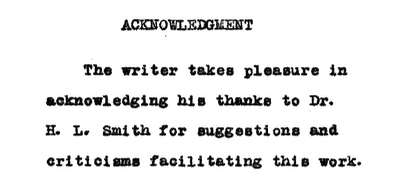
Frank Rickey’s acknowledgement to H.L. Smith for being his PhD advisor.
References
[1] Louisiana State University Department of Mathematics, “History of the Department – from the 1998–1999 Program Review Self-Study.”
[2] “Herman Lyle Smith,” obituary notice, Mathematics Magazine 24, no. 1 (September–October 1950).
[3] Celebratio Mathematica / E. H. Moore students record, Herman Lyle Smith.
[4] E. H. Moore and H. L. Smith, “A General Theory of Limits,” American Journal of Mathematics 44 (1922), 102–121.
[5] Frank Atkinson Rickey, Foundations of Differential Geometry, Ph.D. dissertation, Louisiana State University, 1935.
[6] Harry Taylor Fleddermann, Density Properties of Sets, Ph.D. dissertation, Louisiana State University, 1940.
[7] Manya Raman-Sundström, “A Pedagogical History of Compactness,” The American Mathematical Monthly 122, no. 7 (2015), 619–635.
[8] John L. Kelley, General Topology. Princeton: D. Van Nostrand, 1955.
[9] Henri Cartan, “Théorie des filtres” and “Filtres et ultrafiltres,” Comptes Rendus de l’Académie des Sciences (1937).
[10] H. L. Smith, “A General Theory of Limits,” National Mathematics Magazine 12, no. 8 (1938), 371–379.
[11] E. J. McShane, “Partial Orderings and Moore-Smith Limits,” The American Mathematical Monthly 59 (1952), 1–11.
CHANNEL: Baldridge Theorems


 Scott Baldridge